Website development rarely fails because the team can't code well. Far more often, it fails because nobody wrote down in advance what is being built, in what order, and what business goal the whole thing serves.
A digital roadmap is a documented decision-making and prioritisation framework built on business goals. It defines which digital developments a company should carry out, in what order, with what dependencies, and for what measurable business outcomes. This article walks through what a good roadmap contains, how it is built from assessing the current state all the way to measurement, what role AI plays in it, and how we think about it at W5labs.
What a digital roadmap really is
A digital roadmap is the decision-making framework that shows where a business is heading digitally and through which steps it gets there. It doesn't describe the current state. It describes the path between the current state and the desired state, and this series of decisions always ends in a concrete, documented output that the team and decision-makers can refer back to.
To get there, it's worth drawing a sharp line between three concepts that are often blurred together in practice:
- Digital strategy = where and why.
- Digital roadmap = what, in what order and for what outcome.
- Project plan = how, who and by when.
A good roadmap, then, is not a technical document but primarily a business decision-making tool. At the same time, technological feasibility, system dependencies and available resources already play a part when priorities are set, not only later, during implementation.
Why at the start, and not along the way
Where most companies go wrong is that they only discover during development what they actually need. Halfway through a website redesign, it turns out a customer portal is needed too. Halfway through building the customer portal, it turns out the data lives in other systems that first need to be connected. Every discovery means more delay and more cost, because development is already underway when the decision is made.
The roadmap reverses this order: a significant share of the key strategic and prioritisation decisions is made before development, while changing them is still cheap, not during it, when it's already expensive. Whatever can be decided in advance doesn't need to be redesigned along the way.
This is especially true when development involves several teams, such as marketing, sales and customer service. Without a roadmap, every team tries to understand what is being built and why from its own perspective, which leads to conflicting priorities and misunderstandings.
In short. Creating the roadmap early doesn't slow development down, it speeds it up, because the big decisions are made at the start rather than in the middle of the work, while corrections are still cheap.
What a good digital roadmap is made of
A roadmap is not a standalone document but one stage of a continuous cycle: it starts from the current state and, through measurement and then feedback, returns to the next round.
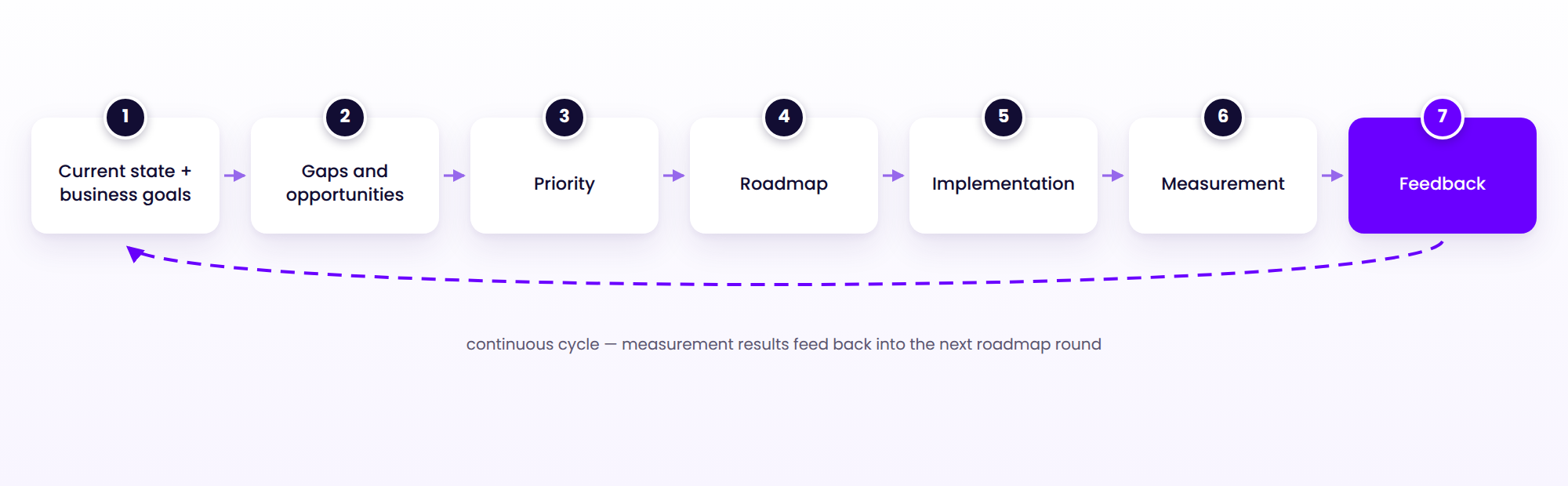
Within this cycle, the roadmap itself rests on five elements that build on one another but each answer a different question.
Current state and business goals. The roadmap starts from two inputs at once. One is a clear view of what works today, where the constraints, dependencies and untapped opportunities are. The other is knowing exactly what the business wants to achieve: grow revenue in a new market, reduce customer service workload, prepare for a rebrand, retain existing customers or speed up an internal process. Technology only comes after this, not before.
Gaps and opportunities. A gap is simply the difference between the current state and the desired business goal: what is missing for the business to get from where it is today to where it wants to be. Without this, the assessment of the current state and the business goals remain separate observations, and the roadmap turns into a wish list.
Priorities. Not every development is equally urgent, and ranking can't be reduced to two factors. For us, this is driven by a simple five-criteria prioritisation framework: we run every possible development direction through the same five criteria before putting them in order.
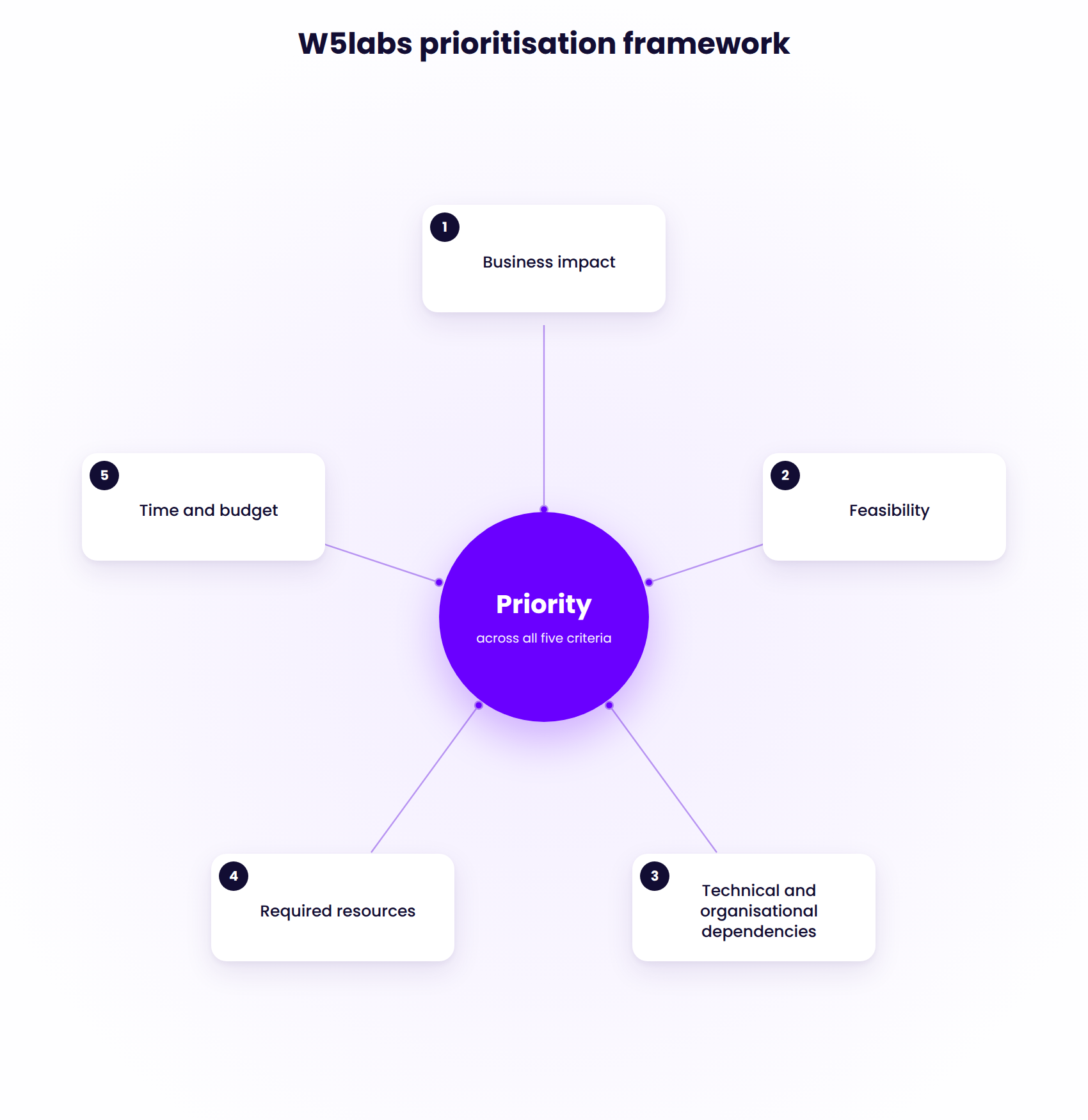
A development can move further down the list even if it would have a large business impact on its own, if it depends on a system or data source that isn't yet available. We set priorities by weighing all five criteria together: the development that moves up the ranking is the one that is strongest overall, not the one backed by the loudest interest in the organisation.
Milestones, ownership and review. The roadmap breaks the work into concrete, time-bound phases, each of which delivers value on its own. Every milestone has an owner who makes decisions and oversees delivery, and there is a regular – typically quarterly – review point when the team checks whether the ranking still holds up.
Measurable outcomes. Every milestone has a metric that shows whether the goal was achieved. Without it, the roadmap remains just a nice plan whose impact nobody can prove – we cover exactly which metrics we mean in a separate section.
The value of a good roadmap lies not only in showing what is worth developing, but also in helping filter out ideas that wouldn't currently create proportionate business value. A "no" decision is just as much an outcome as a new development direction, because it frees up resources for what really matters.
In short. Together, the five elements ensure that the roadmap doesn't just say what is being built, but also why it's worth it, who is responsible for it, which constraints and dependencies shape its delivery, and how we'll know it worked.
The role of AI in a digital roadmap
In W5labs' AI-first approach, the question isn't only where we can build in an AI feature. It's just as important to think through how AI itself can transform a given business or digital process – in customer service, content creation, lead qualification or internal operations.
A useful way to think about this is a simple AI-readiness ladder. The ladder has five steps, builds from the bottom up, and each step rests on the one before it.
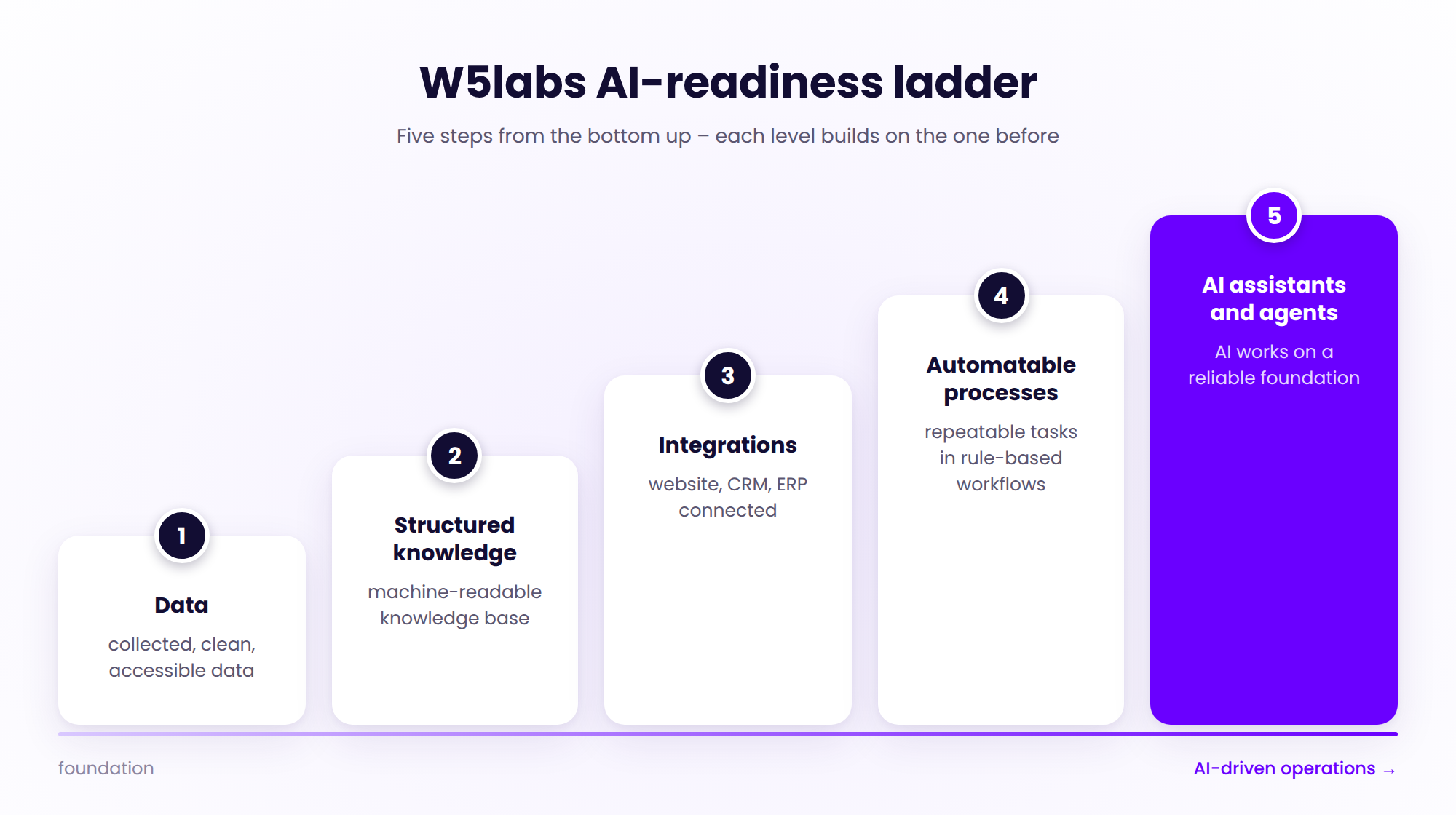
- Data. The company's business data is collected, clean and available in an accessible form.
- Structured knowledge. Data and expert knowledge become a unified, well-organised, machine-readable knowledge base.
- Integrations. Systems – such as the website, the CRM and the ERP – are connected, and data no longer lives in silos.
- Automatable processes. Repeatable, rule-based processes are built on top of the connected data and knowledge.
- AI assistants and agents. On this reliable foundation, AI supports the work or carries out tasks on its own.
For the digital decisions made today, it's already worth examining whether the infrastructure being built will be suitable for AI-based operation later, not just whether it meets today's needs.
In parallel, it's worth examining another, related but distinct question: how searchable, understandable and citable the company's digital knowledge is for AI systems themselves. This is the AI Visibility dimension, which the next section covers.
Regardless of all this, an AI feature only makes it onto the roadmap if it can create demonstrable business value – reducing workload, speeding up a process, improving customer experience, raising lead quality or opening up a new business opportunity – not because it's technologically possible.
A good digital roadmap isn't one that features a lot of AI, but one that shows where AI creates measurable business value.
SEO and AI visibility are decided at roadmap level
When planning a new website or digital platform, searchability and interpretability by AI systems are not an after-the-fact marketing task but a roadmap-level decision. This is already the point to define what information architecture, content areas, expert knowledge, structured data and technical foundations will be needed for the system to be understandable to Google and AI-based search engines as well.
At roadmap level, therefore, the question isn't only which technical and content foundations are needed. It's just as important to clarify:
- on which topics and questions the company wants to become an expert source
- what original expert content this requires
- what information and entity structure needs to be built
- what technical conditions are needed for it
- how we will later measure changes in Google and AI visibility
For us, this assessment is supported by GVS, the Growth Visibility Score: W5labs' own documented measurement methodology, which evaluates a company's digital presence across six dimensions (AI visibility, searchability, technical performance, message and content, conversion path and measurability, trust). Key elements of AI visibility measurement include Brand Coverage, Share of AI Voice, average brand position and URL-level diagnostics. The output of GVS is a score and a business diagnosis of where the company's digital presence is holding back growth, and what the next step on the roadmap should be as a result.
In practice, this means a roadmap item doesn't look like this:
Q2 – new website
but like this:
Q2 – new website that lays the technical and content foundations for lead generation, SEO and AI visibility, the right information architecture, measurability and future integrations.
This way, from an SEO and AI Visibility / GEO perspective, we aren't trying to optimise an already finished structure after the fact – the structure is built from the start to be fit for it.
A W5labs example roadmap for a typical B2B situation
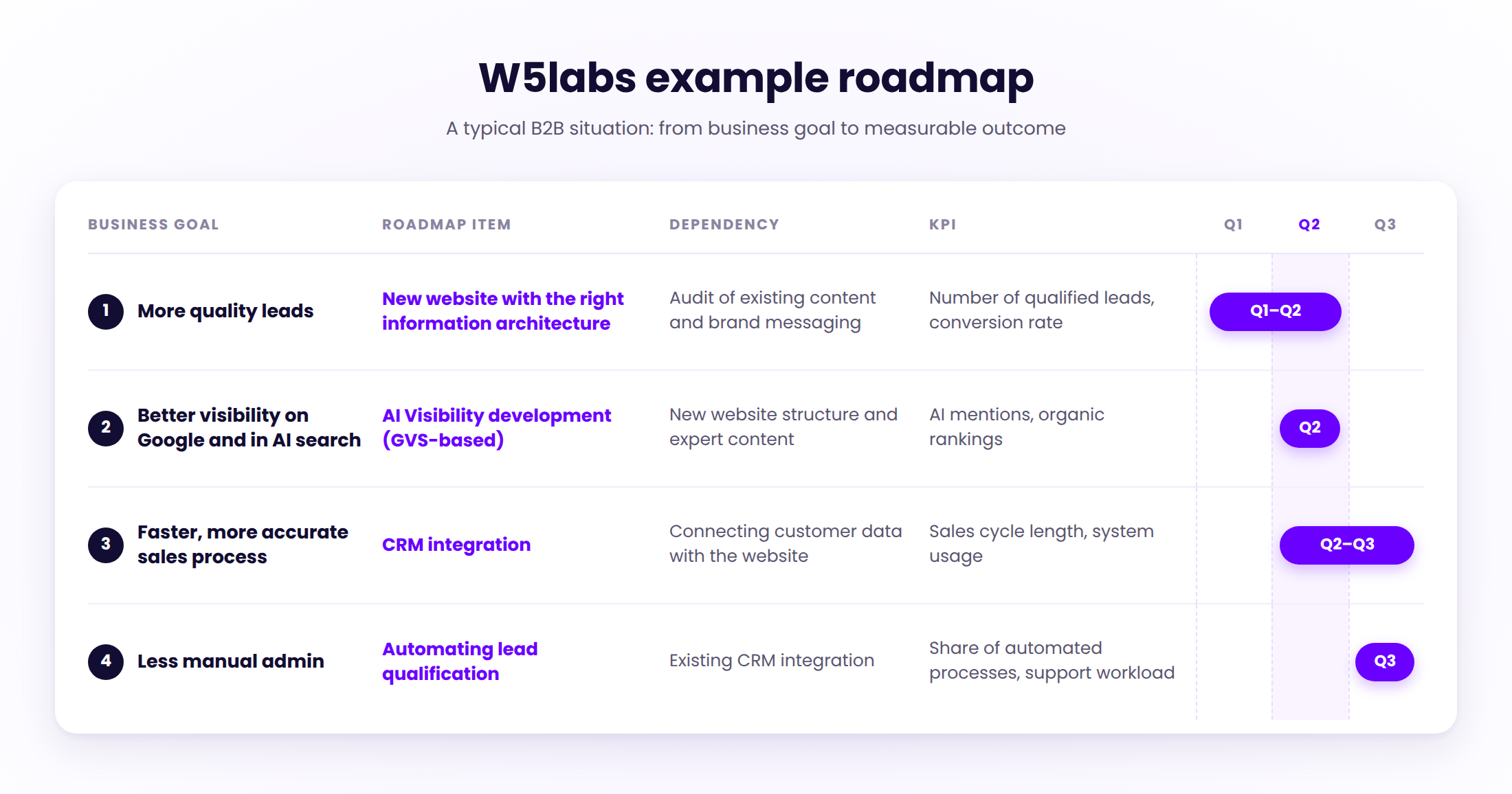
The table below is W5labs' example roadmap: it shows how we derive a concrete roadmap item from a business goal, followed by its dependency, metric and timing. It is a general example of a typical B2B situation, not a specific client's plan.
What a company receives at the end of the digital roadmap
The roadmap process isn't intangible strategic consulting but a concrete, documented output that the team and decision-makers can refer back to in the period ahead. In practice, it typically includes:
- a summary of the current digital state and the most important problems
- the business goals and the digital opportunities linked to them
- the development priorities, together with the ranking criteria
- the key technical and organisational dependencies
- the milestones and the expected order of delivery
- the owners and KPIs linked to the milestones
- the next concrete steps
This is what sets a roadmap apart from a general direction-setting document: it doesn't just say which way to head, but also what the first concrete step will be, and what the next one depends on.
How we measure whether the roadmap has worked
Every milestone has a measurable goal. The metric depends on the nature of the development and the business goal of the given roadmap item, rather than being picked from a generic list. The following are examples of metrics we use regularly, not a KPI set to be applied the same way everywhere:
- number of qualified leads
- conversion rate
- organic visibility and relevant SEO rankings
- relevant AI mentions, citations, appearances as a source and Share of AI Voice in questions that matter for the target market
- length of the sales cycle
- share of automated processes
- support workload
- system usage
- revenue or working time saved
AI mentions or Share of AI Voice are typically the relevant metrics for an AI Visibility development, while for an internal automation project, support workload or the share of automated processes is what shows whether the development has worked. Here too, the goal isn't simply for an AI system to mention the company somewhere, but for the company to be visible in the questions that matter commercially in its own market.
Without a roadmap and with one
The bad scenario. A company builds a new website because the old one looks outdated. After six months of development, it turns out that marketing expected a completely different set of features than sales had asked for, and the developers have meanwhile half-built both, following contradictory logic.
The good scenario. Before development, the same company sits down with marketing, sales and customer service, jointly defines the business goals for the coming year, derives the developments from them and then puts them in order. Development follows the roadmap, and every team knows what to expect and when.
The difference isn't in how capable the team is, but in when the decisions are made.
A company often starts with "we need a new website". During the roadmap process, however, it often turns out that the real problem lies elsewhere: too few quality leads come in, the company is poorly visible on Google and AI-based platforms, salespeople qualify incoming enquiries manually, there is no proper CRM integration, expert knowledge isn't published, and customer data is scattered across several systems.
That's when it becomes clear that this isn't simply a website project. There is a digital growth problem, and the website is only one part of it, which can only be seen clearly at roadmap level, before development begins. The client arrives with a website problem, but the assessment often uncovers a more complex digital growth question – and this is the point where the real value of the roadmap shows.
A simple analogy
Imagine building a house without a floor plan. The bricklayers make progress, then it turns out the bathroom is going where there's already a wall, and the electrician has planned the wiring where the kitchen units will later go. Every trade does good work, yet what has already been built has to be torn down.
The digital roadmap is this floor plan: it doesn't tell you how to build a wall, but where the bathroom goes before anyone starts laying bricks.
Typical mistakes when creating a roadmap
- Treating it as a feature list. A roadmap doesn't list which features there should be, but which business problem a development solves.
- One-person decisions. If the roadmap is created only from the perspective of management or only from that of the development team, it will miss the considerations that only sales or customer service can see.
- Overly rigid planning. A roadmap is not a contract set in stone but a living document that should be reviewed at a frequency that depends on the company and the nature of the development programme.
- Missing metrics. Roadmap milestones without measurable goals are just deadlines, not business outcomes.
The W5labs approach
For larger and more complex digital developments, the project starts with the roadmap, before any design or development work begins – as we'll see, a smaller, single-function development doesn't necessarily need a separate roadmap. We see that the businesses that get further are the ones willing to invest time in planning first, rather than rushing straight into delivery.
The process fits into our own service system, which rests on four pillars: Strategy → Creative → Development → Support. In the Strategy phase, we assess the current state, the business goals and the problems, identify the opportunities – website, automation, AI, system integrations – and the roadmap comes together from this. This also includes assessing digital visibility, through GVS.
Based on this, Creative and Development design and build the right digital solution, from interface design and content concept to integrations, AI features and automations. Support then ensures continuous operation, further development, follow-up, measurement and optimisation, and we feed the results back into the next strategic and development decisions.
For us, then, the roadmap isn't a document created at the start of a project and then forgotten, but a continuous decision-making system.
A roadmap isn't paperwork. It's a decision about what matters now.
When a separate roadmap isn't necessary
For a very small, single-function development, such as updating a landing page, the full roadmap process would be overkill. A roadmap delivers real value where several development directions, several teams or a longer time frame are involved, and decisions affect one another.
A digital roadmap is neither a luxury nor a formality, but the layer that connects business goals with technological delivery. Those who invest time in it at the start reach their goal with less redesign, less conflict and clearer priorities.
Don't start digital development with technology. Start with what you want to achieve as a business – and only then decide which technology, website, SEO, AI or automation you need for it.