When a client first reaches out about a new website, the same question comes up almost every time. How long will it take? The answer rarely fits into a single sentence, even though most people are hoping for one exact number, say three weeks or a month. The reality is considerably more nuanced, and understanding that nuance is exactly what's worth doing before anyone commits to a build.
As a quick answer, based on W5labs' own project experience, a simple brochure site typically takes 3 to 5 weeks, an SME or corporate site with basic functionality 5 to 8 weeks, a more complex corporate website 8 to 12 weeks, while a webshop takes 2 to 4 months, and a custom-built system can take 3 months or considerably longer. These are indicative timelines that hold when the right inputs are available and the client stays engaged throughout, and the actual project schedule is always set once discovery is complete. Below, we break down what this time is made up of, how the process splits into stages, and what most often causes delays. The goal isn't to make the picture look intimidating, but to make it realistic.
Why there's no single right answer to this question
A website isn't one task, it's a series of projects that build tightly on one another. Planning, design, development, and content each run on their own timeline, and how long each one takes depends on how big the site is, which features need to be built, how many decision-makers are involved, and how clear the starting concept is.
Across W5labs projects, we see the same question get two completely different answers depending on what "website" actually means for that particular project. A simple brochure site can come together in a matter of weeks. A complex webshop that integrates with a warehouse management system and runs in multiple languages can take months.
There's another reason this question is hard to answer precisely. Website development isn't a linear process, it's a system made up of many small moving parts, several of which run in parallel. While the development team is building the technical foundation, the design might already be finished while the content is still missing. This parallel structure often speeds the project up, but it also means that a single bottleneck on one track can ripple through the entire schedule.
A website's development timeline is shaped primarily by the project's complexity, the number of integrations, how quickly content comes together, and how fast the client can turn approvals around.
What a website's development timeline is made up of
The process breaks down into several clearly distinct steps. It's worth treating them separately, because each one has its own logic, its own risks, and its own people involved.
- Discovery and strategy. Usually anywhere from a few days to two weeks.
- Design and user experience. One to two weeks for simpler sites, three to four weeks for more complex projects.
- Development. Two to four weeks for a standard site, considerably longer for a complex system.
- Content. Runs in parallel with development, and is, in our experience, the most common source of delay.
- Testing and launch. One to two weeks on average.

Discovery and strategy
Every project that goes well starts here. This is the stage where we identify who the target audience is, what the website's business goal is, what content and functionality it needs, how it fits into the company's digital strategy, and what competitive landscape it has to hold its own in. Discovery looks like the step most tempting to rush through, yet it's what the entire project's success is built on.
In practice, a thorough discovery phase at W5labs can take anywhere from a few days to as much as two weeks, depending on the project's complexity. Whoever skips or shortens this step ends up losing that saved time later, in the later stages of development, when it turns out an important feature never made it into the plans, or that the target audience actually needs something quite different from what the site was originally built to deliver.
The output of discovery is a fixed project foundation that captures the site's purpose, core features, structure, and expected outcomes. That foundation becomes the reference point for every decision that follows, which is exactly why it's worth spending as much time on it as it genuinely needs.
Design and user experience
The design stage is where the site's visual language and user journey take shape. This is where it's decided how visitors will navigate, what they see first, how the site guides them toward conversion, and how the visual identity aligns with the brand's messaging. Thoughtful UX design isn't decoration, it's a business tool, one that can meaningfully influence conversion rates and visitor engagement.
The design phase can take one to two weeks for simpler sites, three to four weeks for more complex systems, especially when several rounds of review happen with the client. A typical design process includes sketches, then fully worked visual concepts, followed by incorporating client feedback, which often takes place over several rounds.
It's worth noting that the number of feedback rounds is itself a major factor. If a new person joins the decision-making process on the client's side in every round, that alone can significantly extend the design phase, even if the design work itself moves quickly.
Development
Development is the part most people picture when they hear "building a website," even though it's really just one link in the chain. This is where the technical foundation gets built, the chosen technology stack and content management system, the custom features, and the necessary integrations. Development is also where the technical SEO foundations get put in place, along with the structural and technical choices that help both traditional and AI-based search engines understand the content properly.
This stage refers specifically to the technical build itself, not to the total project timeline, which, as mentioned above, falls into the 5-to-8-week range once discovery, design, content, and testing are included. Technical development for a standard corporate website typically takes two to four weeks; a webshop or a system with custom functionality takes considerably longer, sometimes two to three months. Development time depends heavily on how many external systems the site needs to communicate with, how custom the functionality is, and how thorough the testing needs to be.
It's also during development that gaps from the discovery or design phase tend to surface. The most expensive situation for a development team is having to retrofit a feature into a system that's nearly finished, since that usually takes more work than if it had been part of the plan from the start.
Content
Based on W5labs' project experience, delayed content is one of the most common causes of delay in website development, even though content production gets the least attention during planning. Writing, sourcing images and video, and then uploading and optimizing all of it is real work, and it's often done in parallel with development so it doesn't needlessly extend the project.
The risk of content-related delays is especially pronounced on multilingual corporate sites. On one project, a company website running in six languages, the factor that ended up shaping the timeline the most wasn't development, it was producing and translating the content across languages, page by page, block by block, since every language version also had to be reviewed and approved. When content is late on the client's side, it almost automatically pushes back the entire schedule, no matter how well the development team is keeping pace.
Clarifying who owns the content and by when, early, during discovery, is in practice one of the biggest time-savers in the whole project. In most projects it's worth settling early who will write the copy, where the images will come from, and when all of it can be expected.
Testing and launch
The final stage covers functional testing, checking the mobile view, fine-tuning load speed, and final sign-off. Testing and launch looks like the shortest stage, yet it's where the small issues surface, the ones that take time to fix and that are critical to catch for the sake of the user experience.
A thorough testing and launch process takes one to two weeks, longer for more complex systems. This includes checking across different browsers and devices, reviewing security settings, and post-launch monitoring, which can call for quick fixes based on what the first few days reveal.
From a simple site to a complex system
The type of project fundamentally determines what's a realistic timeframe. The table below shows indicative figures based on W5labs' own project experience, not fixed commitments or external industry benchmarks. These timeframes hold when the right inputs are available and the client stays engaged throughout; the exact schedule is always set once discovery is complete.
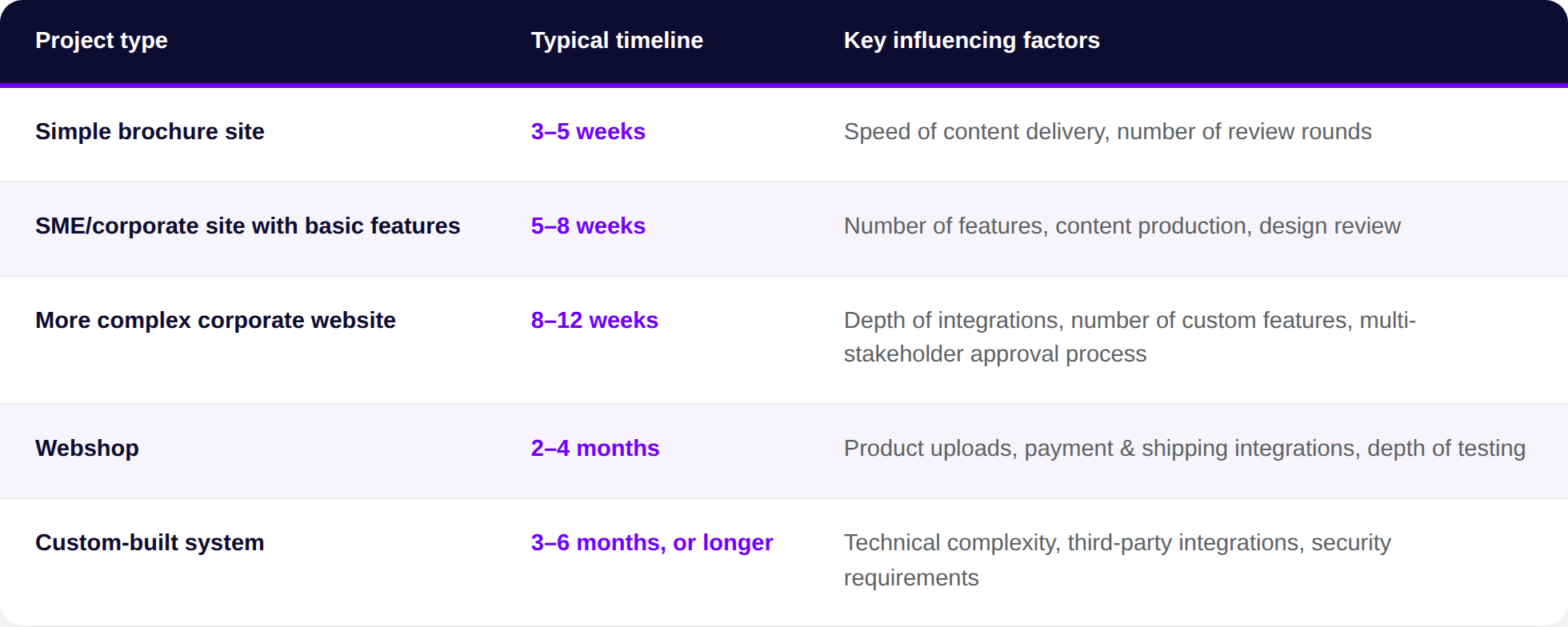
This table is simply a compass. The real schedule always adapts to the specifics of the project at hand, and in many cases even these timeframes can shift if new requirements come up along the way.
What a typical project lifecycle looks like in practice
It's worth seeing how all of this fits together, using a more complex corporate website as an example. The first two weeks cover discovery, which is when the structure and core messaging take shape. Weeks three and four are spent on design, which the client approves, sometimes after one or two rounds of revisions.
Development starts in week five and runs in parallel with content production. If content arrives on time, development typically wraps up around week eight. One to two weeks of testing follow, then launch. A project like this typically comes together in nine to eleven weeks, assuming there's no significant delay at any stage, which lines up with the 8-to-12-week range typical for more complex corporate websites.
This example shows clearly that most of the time doesn't go into the coding itself, it goes into the back-and-forth, the decisions, and producing the content. That's the realization many clients only fully arrive at partway through the project.
What actually slows projects down
Based on W5labs' project experience, most delays aren't technical in origin. The most common causes are well understood and largely avoidable, if they're identified early.
- Late content. Missing copy and images stall the final step of development.
- Drawn-out feedback rounds. These weigh especially heavily when a decision-maker is hard to reach, or when a new person joins the process in every round.
- Third-party-dependent integrations. Connecting a payment provider or an external system, incomplete API documentation, or work required on a partner's side are factors whose timing isn't always in the development team's hands.
- Slow internal approval processes. When sign-off touches multiple departments, marketing, leadership, sometimes legal, every additional stakeholder adds another round.
Access to an external ERP or CRM system's API, a payment provider integration, or a task that depends on a partner's own development work can all create dependencies whose timing isn't solely up to the web development team. These kinds of third-party dependencies can be clarified early, during integration planning, and getting ahead of them matters just as much for the schedule as the development team's own pace.
What happens when the scope changes mid-project
Scope change is one of the most common, yet least discussed, causes of project delays. A feature that was originally planned to be simple expands during development, a new idea comes up, or a previously agreed-on solution turns out not to be enough. Scope change is a natural part of most projects, the real question isn't whether it can be avoided, but how it's handled.
Mid-development scope change can be handled well when its time and cost impact is clarified before the work begins, and the team only proceeds once that's settled. Poorly handled scope change, by contrast, quietly accumulates, and it's only at the end of the project that the full extent of the extra work becomes clear.
How to realistically speed up the process
Speeding things up doesn't mean skipping steps, it means organizing them well alongside each other.
- Naming a single internal owner. Right from project kickoff, someone who consolidates feedback and can make smaller decisions independently.
- Working in parallel. Content preparation should run alongside design, not start after it.
- Modular rollout. The first version is built around the most important features, with less critical elements arriving in a second phase.
It's worth noting an important distinction: getting to market faster doesn't necessarily mean speeding up the exact same full project with the same resources. In many cases, it's more effective to launch with a well-defined first version, then bring in less critical functionality in subsequent development phases.
At W5labs, this approach is reflected in the process chain we run under Strategy, Creative, Development, and Support: this structure prevents the most costly scenario of all, a decision turning out to be wrong midway through development because no one thought it through early enough. Strategic groundwork doesn't slow a project down, it's precisely what speeds up development and testing, because fewer unexpected turns come up along the way, and the team already knows from the outset which goals should guide the smaller decisions.
What the client can do to keep their own project on schedule
A website project's success doesn't rest on the development team alone. Client-side responsibilities, providing content, giving timely feedback, and streamlining internal approvals, carry just as much weight as the technical work.
- Naming a single point of contact. Someone responsible for internal communication.
- Starting content production early. Right after discovery wraps up, not at the last minute.
- Gathering feedback in a structured way. Collected in one place, so the development team isn't left piecing together scattered, contradictory requests from different channels.
The most honest answer to "how long does it take to build a website" is that it depends on how clear the goal is, how complex the feature set is, and how fast collaboration moves on content and approvals. Anyone who understands the website development process stage by stage goes into a build with far more realistic expectations, and reaches launch with far less frustration.
The good news is that, based on our own project experience, most delays aren't technical, they're organizational, which means they're largely manageable and plannable if both sides prepare for that from the very start of the project.
That's why the first real question in a web project isn't how many weeks it will take, it's exactly what it needs to achieve for the business. Once that's clear, a realistic schedule, budget, and development process can all be built on top of it. A well-structured discovery phase is exactly what clarifies that, and from it comes a realistic scope, timeline, and development plan.