
A procurement manager today can easily start a supplier search by typing into ChatGPT: "Which companies in Hungary make custom hydraulic cylinders in small batches?" The answer lists four or five names, each with a short justification. If your company is not among them, the request for quotation may never reach you, and no report will ever tell you about it.
This is the situation GEO, or Generative Engine Optimization, was created for. The concept attracts a lot of hype and misunderstanding. This guide therefore sticks to what can actually be known from public sources and from our client work: what GEO means, why it is a business issue, how it differs from SEO, what is proven and what is not, and how to get started.
In brief
What is GEO? Generative engine optimization: the content, technical and credibility improvements that increase the chance of a business appearing with accurate information in the answers of ChatGPT, Google AI Overviews, Gemini or Perplexity.
Why does it matter for a business? Many buyers now ask an AI assistant for recommendations before choosing a provider. A company that the answer does not mention, or describes inaccurately, can easily drop off the shortlist.
How is it different from SEO? SEO supports visibility in search results and the traffic that comes from them. GEO supports whether the company appears in the answer an AI puts together, and whether what it says about the company is correct. They share the same foundations, and GEO complements SEO.
How can its effectiveness be measured? With a fixed set of questions run regularly on the main AI platforms, combined with web analytics data. Search Console shows the number of impressions in Google AI Overviews and AI Mode, but not clicks or the queries that triggered them. There is no guaranteed appearance, but change over time and your position relative to competitors can be tracked.
What should you do first? Start by putting together 10–15 real customer questions, then check how the main AI assistants answer them, whether they mention your business, and which sources they rely on.
What is GEO?
GEO (Generative Engine Optimization) is the set of content, technical and credibility improvements aimed at making a business, brand or website more likely to appear with accurate and relevant information in answers produced by generative artificial intelligence, for example in ChatGPT, Google AI Overviews, Gemini or Perplexity.
GEO does not replace traditional search engine optimization (SEO). It complements it by also paying attention to appearances in AI-generated answers, the accuracy of the information given about the brand, and the sources being cited.
The term was popularized by a 2023 research paper, and it has since circulated in the industry alongside AEO (answer engine optimization) and AI Visibility.
Two concepts we consistently keep apart
GEO – the work: the set of content, technical and credibility improvements that can increase the chance of appearing in AI answers.
AI Visibility – the measurable result: how often, in what context and with what accuracy a business appears in the AI answers examined.
How do we approach GEO at W5labs?
W5labs designs and builds digital systems that serve business growth, and within these systems GEO is one measurable area. The measurement and decision-support part is provided by our own Growth Visibility Score (GVS) methodology: we use it to assess how visible a business is in search engines and AI systems, which digital gaps may be holding back its growth, and which improvements should take priority. For us, the ultimate goal of GEO is for the business to be there when a potential client puts together the list of partners worth considering.
Why is AI visibility a business issue?
For many buyers, the decision now starts in a conversation with an AI assistant, and what is said there influences which companies make it onto the list of potential suppliers. AI visibility is therefore also a question of customer acquisition and competitiveness. It is worth looking at from three angles.
New business opportunities
When a potential client is looking for a provider and the AI assistant recommends a few names, further research typically starts from that short list. The question is whether your business appears in these recommendations for the questions your target audience actually asks.
Competitiveness
An AI answer rarely mentions just one company. If the system presents your competitors in more detail, with more up-to-date data or citing stronger sources, that gives them an advantage in the comparison before the decision, even if your offer would fit the need better.
Business risks
An outdated site address, a discontinued product, a certification the system does not know about. Because of one incorrect or incomplete statement, a prospect may never get in touch. This loss does not show up in web analytics either, since the visit never happens. The most common risks:
Lost prospects: a business that does not appear in the recommendations is unlikely to be contacted by the potential client.
Loss of trust: a wrong address or a service no longer offered creates uncertainty for the decision-maker.
Missed sales opportunities: a competitor that is presented more accurately gains the upper hand in the comparison.
Wasted effort: handling prospects who refer to an incorrect price or a discontinued product takes up time in sales and customer service.
Question for decision-makers | What can GEO answer? |
|---|---|
What business outcome can it support? | It can help the business make it onto the list of providers that potential clients consider. |
What problem can it help prevent? | Inaccurate, outdated or incomplete information about the business can be spotted and corrected in time. |
What cost or risk can it reduce? | It can help avoid poorly prioritized development work, unnecessary content production and misunderstandings caused by incorrect information. |
What decision does it support? | It shows which content, technical or credibility improvements are worth tackling first. |
Improving AI visibility does not guarantee more traffic or revenue. What it can influence is whether the business makes it into the small group from which the buyer eventually chooses.
Do you know whether ChatGPT recommends your business?
With the W5labs Growth Visibility Score (GVS) methodology, we examine how your business appears in search engines and AI systems, what information about you is missing, and which digital improvements could help increase your visibility. The first step is the free GVS Snapshot, which gives a preliminary picture in three areas.
How is GEO different from SEO?
SEO supports organic search visibility, relevant traffic and conversions. GEO examines and improves whether the business appears in AI-generated answers, whether what is said about it there is accurate, which source the system cites, and how it compares with competitors. The foundations are shared, and GEO complements the existing digital visibility strategy.
Aspect | SEO | GEO |
|---|---|---|
Goal | Organic search visibility, relevant traffic and conversions | Appearances, accurate statements and citations in AI-generated answers |
Measurement | Ranking, impressions, clicks, conversions | Appearance rate, accuracy, cited sources, visibility relative to competitors |
Unit of content | Page, topic and search intent | Statement, fact, entity (company, product, service) |
Foundation | Indexability, content, links, user experience | The same, plus clear entities and verifiable facts |
Business impact | Visits, enquiries and purchases on the website | Inclusion in pre-decision answers, sometimes with a click, sometimes with a mention only |
An example of the difference
With SEO, we look at where an industrial manufacturer's website ranks for the search "custom hydraulic cylinder manufacturing".
With GEO, we also look at whether, when a buyer asks ChatGPT to recommend Hungarian hydraulic cylinder manufacturers, the company appears in the answer, whether the information about it is accurate, and which sources the system cites.
Google's position on this is clear. According to its guide to optimizing for generative AI features, from Google Search's perspective, optimizing for AI search is optimizing for the search experience, and therefore still SEO. The same guide urges caution about third-party tools that promise ranking success or claim to use "internal" Google metrics, and recommends checking their advice against the official guidelines.
We agree, which is why we do not treat GEO as a separate magic formula either. Two things are worth adding, though. ChatGPT, Perplexity and Claude are not Google's systems: they work with their own source selection and their own answers, so visibility in them has to be checked separately. The unit of measurement changes too: a page can rank first on Google while an AI answer states outdated information about the company.
How is an AI answer put together?
Search-based AI features typically retrieve relevant pages from the search index, build the answer from them and show links alongside it. For its own AI features, AI Overviews and AI Mode, Google names two techniques.
Retrieval-augmented generation (RAG): the system retrieves relevant pages from the search index and generates the answer based on their content, with clickable sources.
Query fan-out: the model launches several related queries behind a single question to gather information from multiple angles. In the manufacturer example, these could be "hydraulic cylinder manufacturer Hungary", "small-batch cylinder manufacturing" or "custom cylinder lead time".
This description applies to Google's systems. Web search in ChatGPT, Perplexity or Claude may also rely on real-time source retrieval, but they use their own search back ends, source selection and wording, and fewer public details are known about how they work internally. Google's model should therefore not be projected onto them one to one.
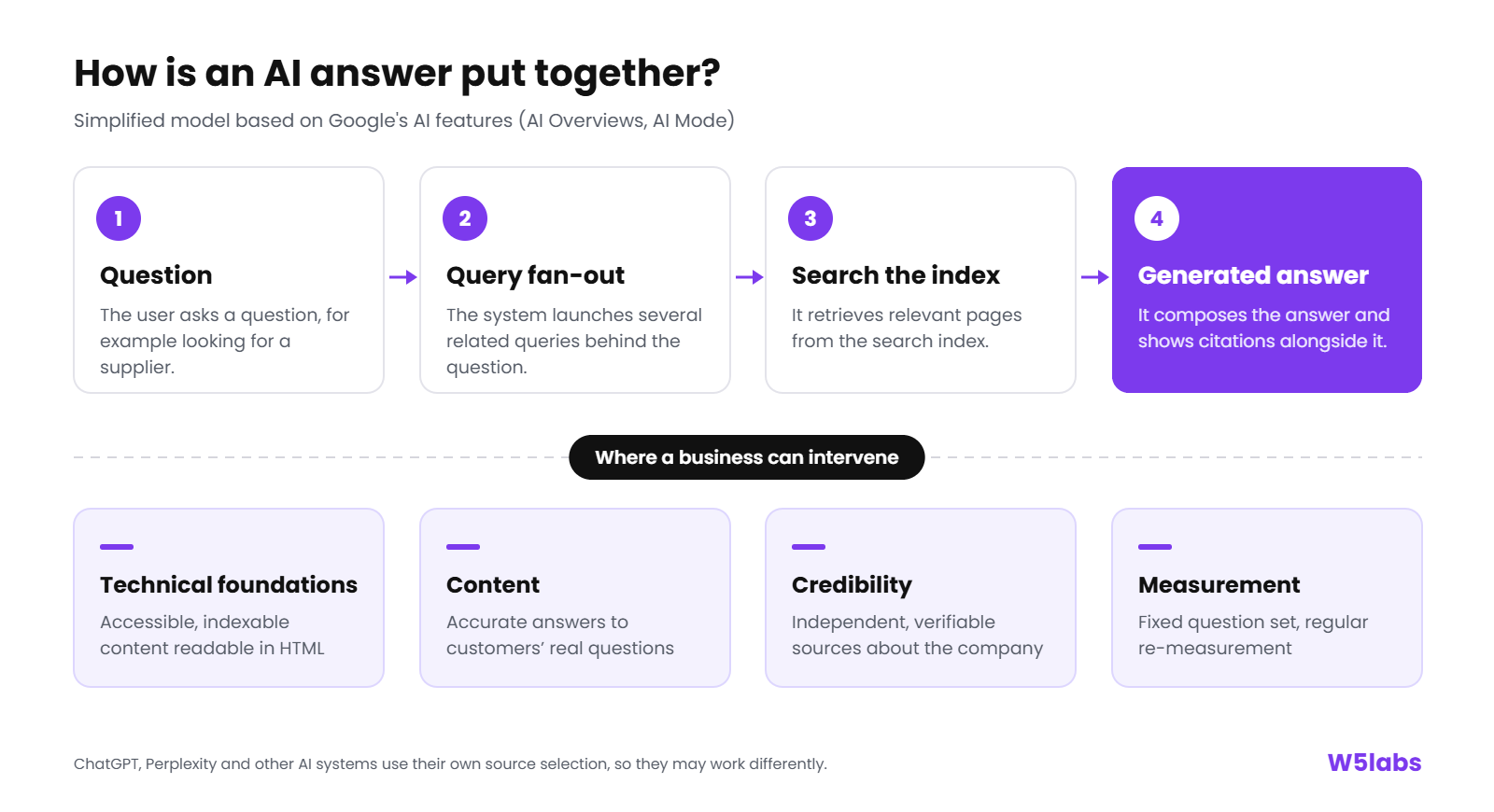
A simplified model of how Google's AI-powered search features work. Individual systems may search, select sources and compose answers differently.
Two practical conclusions follow from this. Complete, well-organized coverage of a topic is worth more than a single keyword. And according to Google's guidance, to appear as a supporting link in AI features, a page must be indexed and eligible to be shown in search results with a snippet. That is why the technical foundations of traditional SEO remain decisive in AI search.
The picture above is a simplification. AI systems differ in how they search, choose sources and phrase answers, and we do not know their internal workings in full detail. What a company can influence comes down to three questions: can the system access the content, can it interpret it, and does it consider it reliable enough to use? Most GEO work is therefore about making content accessible, understandable and credible.
What does the research show?
According to the first systematic study on GEO, certain content methods can noticeably improve a source's visibility in generative answers, but the effect varies by domain.
The paper "GEO: Generative Engine Optimization" by researchers at Princeton University and partner institutions, accepted at the KDD 2024 conference, measured visibility improvements of up to 40 percent with some content methods. This figure is the best result measured on the authors' own question set and test environment. It is not an average, and it does not mean that any website would improve this much in a live AI system. The authors themselves stress that the effectiveness of the methods varies by topic.
Another frequently quoted figure is Gartner's 2024 prediction that traditional search volume could drop by 25 percent by 2026 because of AI assistants. This was a forecast, not measured data. How far it has come true in your own market is best checked against your own search and traffic data.
So the research supports the idea that the quality and structure of content matter. There is no evidence, however, that any trick delivers guaranteed results.
The four work areas of GEO
We divide GEO work into four areas. For each one we look at the same things: the goal, the common problem, the concrete fix, and why it matters for the business.
1. Technical foundations
Goal: AI systems can access and process the company's most important information.
Common problem: product specifications, capacity data and certifications are only available in PDFs or behind forms, and the names of the company, its services and its sites vary from page to page. For example, the entire product catalog is a single 40-page PDF, and the website only has a download button.
Concrete fix: the site should be indexable and crawlable, important content should also be available in HTML, and naming should be consistent. The PDF can stay, but business-critical data (dimensions, materials, tolerances, lead times) should also appear on structured HTML pages. It is also worth checking that nosnippet or noindex settings do not exclude important pages from Google's AI features, and using the URL Inspection tool in Search Console to see what Google actually receives.
Business relevance: what the system cannot access, it cannot talk about, so the company's expertise may be left out of the answers that precede a decision.
Structured data can help search engines and AI systems associate information with the company more clearly, but according to Google it is not a requirement for appearing in AI features.
2. Content
Goal: accurate, professionally grounded answers to real customer questions.
Common problem: generic text that could be found anywhere, lacking the company's own experience, or, at the other extreme, mass-produced pages written for AI.
Concrete fix: Google's guide specifically highlights "non-commodity" content, meaning content built on first-hand experience and knowledge. For a manufacturer, this could be when it makes sense to order a custom cylinder instead of a standard product, and what lead time depends on. The short answer comes at the start of the section, followed by the details, the table and the example.
Business relevance: potential clients get answers to the same questions the sales team hears every day, so the company's expertise is visible before the decision is made.
Structure serves the reader first and foremost. Google also notes that there is no need to break content into tiny pieces or rewrite it specifically for AI, and that pages mass-produced to manipulate rankings or AI answers violate its spam policies.
3. Credibility
Goal: independent, verifiable sources also give a consistent picture of the company.
Common problem: the company's own website is the only place that says anything about it, the Google Business Profile and industry directories contain outdated or conflicting data, and references are not public.
Concrete fix: consistent core data across external profiles, public references and case studies, genuine professional coverage.
Business relevance: credible mentions outside the website can increase the chance that search engines and AI-based systems form a consistent and verifiable picture of the company, and the same mentions strengthen the decision-maker's trust.
According to Google, artificially generated mentions are less useful than they seem, and its quality and spam systems are designed precisely to filter out this kind of manipulation.
4. Measurement
Goal: find out where the business stands and what changed after the improvements.
Common problem: conclusions drawn from one-off ChatGPT queries, without fixed measurement conditions.
Concrete fix: a fixed set of questions, queries repeated under the same conditions, and regular re-measurement. The next section covers the details.
Business relevance: regular measurement helps track how AI visibility changes after the improvements, and which interventions are worth pursuing further.
The four areas build on each other. Without accessibility, content does not reach the systems; without credibility, it does not become a trusted source; and without regular measurement, there is no way to track how visibility develops after the improvements.
How can AI visibility be measured?
Tracking how AI visibility develops requires regular measurement. AI systems' answers are not deterministic: the same question can produce different answers at different times, and even in consecutive queries. It is therefore not advisable to draw conclusions from a single one-off query. A reliable picture comes from running a fixed question set regularly under the same conditions, asking the same question several times where needed.
What do you need to record for consistent AI Visibility measurement?
the exact wording of the question,
the AI platform,
the time of measurement and relevant conditions (for example the language, the location setting, and whether you were logged in),
whether the business appeared or not,
the competitors appearing in the answer,
the accuracy of the statements made about the business,
the cited sources.
Based on this data, a GEO measurement typically evaluates five aspects:
AI Visibility: in what share of the questions examined the business appears in AI answers.
Brand Accuracy: how accurate, up to date and complete the systems' statements about the business are.
Competitor Visibility: which competitors appear in the same answers, and how often.
Referral Traffic: whether measurable visits reach the website from AI platforms (for example from chatgpt.com or perplexity.ai).
Lead Generation: whether identifiable enquiries come from traffic arriving from AI platforms.
The first three aspects can be measured well by querying the answers regularly. For the last two, data is only partly available. Some visits from AI interfaces appear in analytics without a referrer, and many prospects get in touch after reading an AI answer by searching for the company's name or by phone. These metrics therefore indicate direction, but they cannot fully trace the total business impact.
Measurements apply to the defined question set, AI platforms and period examined. The results are primarily suited to tracking change and position relative to competitors, and they do not automatically represent the entire AI search market. Besides your own improvements, a measured change may also be caused by updates to the AI systems and by competitors' moves, so we interpret the results with these factors in mind.
A simple starter measurement and the GVS methodology
A company can get started on its own with a set of 10–15 questions that its target audience actually asks, run monthly in the main AI assistants. This is a good starting point, but it gives a picture based on few questions and manual recording. GVS goes further: besides search and AI visibility, it also examines where the buyer's journey gets stuck. The parameters in the GVS column differ by package, so each one shows which service it applies to.
Aspect | Your own starter measurement | W5labs GVS |
|---|---|---|
Number of questions | 10–15 questions | GVS Report: about 30 questions. Monthly tracking: up to 45 questions in the base fee, expandable on request. |
Measurement method | Manual queries, repeated monthly | GVS Report: a baseline measurement of at least seven days. Monthly tracking: daily AI visibility checks in ChatGPT, Google AI Overviews and Perplexity. |
Areas examined | Appearance and accuracy in AI answers | Six weighted areas: AI visibility (30%), searchability (20%), technical performance (15%), message and content (15%), conversion path and measurability (12%), trust and accessibility (8%) |
Outcome | A baseline picture and a to-do list | GVS Report: a GVS score from 0 to 100, an A–F grade and a prioritized order of improvements |
What does Google Search Console show?
In brief: the Search Console generative AI performance report shows how many times a link to your site appeared in Google Search's generative AI features, namely AI Overviews and AI Mode. The data can be broken down by page, country, device and date. The report does not show click data or the queries that triggered the impressions, and it does not separate the data for the two AI features. It provides no data on ChatGPT, Perplexity or the Gemini app. Search Console and measurement with your own question set therefore provide different information and do not replace each other: one shows the number of impressions in Google's AI features, the other shows what individual AI systems say about you.
In more detail: Google announced the generative AI performance report on June 3, 2026, initially for a subset of websites. According to the Search Console Help, it has been available to all websites worldwide since August 31, 2026, but it only appears if the site has received enough impressions in Google's generative AI features. It measures a single metric, impressions: how many times a link to your site appeared in Google Search's generative AI features. The help page currently lists AI Overviews and AI Mode here, but not Search Labs experiments, and a separate report covers Discover's generative AI features. The data can be broken down by page, country, device and date, and filtered by search type into text-based or multimodal searches (for example those started with Google Lens).
It differs from the traditional performance report in several ways. The generative AI report's data is also included in the "Web" search type of the existing performance report, and the same limitations apply to it, such as the table's 1,000-row limit. The traditional report also shows clicks, average position and queries, whereas the generative AI report only shows impressions, without a breakdown by query. According to Google's documentation, clicks from AI features are included in the aggregate data for the "Web" search type, and the documentation describes no way to filter them separately. The feature is new, and how it works and what data is available may change, so this description reflects the situation at the time of the article's last update (November 2026).
What could GEO look like at a manufacturing company?
The example below is about a fictional business. It is not the result of a specific client measurement, but illustrates gaps we often encounter on B2B and manufacturing websites.
Take a mid-sized manufacturer in western Hungary that makes custom hydraulic cylinders in small and medium batches. Its website is well organized, it ranks first on Google for its own name, and it holds respectable positions for industry terms too. If we tested the main AI assistants with buyers' typical questions, however, a different picture could easily emerge.
B2B purchasing involves several people, and each asks something different. The engineer asks who can manufacture a cylinder for a given pressure and stroke length. The buyer asks about lead time and whether there is a minimum order quantity. The executive asks who they have worked for and what certifications they hold. At a company like this, typically only the basic company details get mostly accurate answers. The technical parameters are in a PDF catalog, there is no written information about lead times, and the certifications appear only on a certificate uploaded as an image. For these questions, competitors that publish the same data on HTML pages, in a format that answers questions, may gain the advantage.
In a situation like this, the to-do list consists of very concrete tasks:
Problem | GEO intervention | Business relevance |
|---|---|---|
The technical parameters only appear in a PDF catalog | The key parameters are also available on structured HTML pages for each product family | Buyers and information-processing systems can more easily access the data needed for the decision |
There is no written information about lead times and ordering conditions | A separate page on lead times, minimum order quantity and the ordering process | The buyer gets an answer to their most common question in the first round, rather than deciding based only on a competitor's data |
The certifications are only visible on a certificate uploaded as an image | The certifications also appear as text and with structured data | Quality requirements can be verified already at the supplier selection stage |
There are no public references from the main industries | Two case studies from the most important industries | The question "who have they worked for?" gets a verifiable answer |
After a few weeks, it is worth re-measuring with the same questions to see what has changed. We cover the industry context in detail in this article: What does AI Visibility mean for a manufacturer?
If a manufacturer's expertise is not available in an easily processable, verifiable form, it is less likely to become part of AI-based answers.
What is proven, and what is not?
Good SEO, accurate and verifiable content and clear company data demonstrably matter, while the effect of special "AI tricks" is typically unproven.
There is no guaranteed appearance. The same question may get a different answer at a different time or from a different system.
llms.txt has no effect on Google Search. According to Google's guide, Google Search does not use llms.txt or similar files intended for AI, so there they neither help nor hurt. We have covered what it may be worth for other systems in a separate article: What is llms.txt, and does your website need one?
Splitting content into pieces is not a goal in itself. Google's systems can interpret several topics within a single page, and good structure is primarily for the reader.
Manufactured mentions do not work in the long run. They cannot replace a credible, genuine professional presence.
30-day starter plan
The starter plan takes you from the baseline measurement to the first re-measurement in one month. Each week shows the verifiable result and why the task matters for the business.
Week | Task | Result | Business value |
|---|---|---|---|
1. Assessment | Compile 10–15 real customer questions by role, and query them in ChatGPT, Gemini, Perplexity and Google AI Overviews | A completed measurement table: appearance, accuracy, cited sources and competitors for every question and platform | It becomes clear for which potential client questions the business may be missing from AI recommendations |
2. Technical foundations | Check indexability, the sitemap, robots.txt and Search Console, and move critical data from PDFs into HTML | Indexing errors fixed in Search Console, critical data live on HTML pages | We identify and start removing the critical obstacles that make the content harder to access and interpret |
3. Content development | Rework the 3–5 most important pages: a short answer at the start of each section, a table, an FAQ, updated references | The 3–5 reworked pages live, with changes documented and dated | The business's expertise, capacity and references become clearer and more visible |
4. Re-measurement | Make core company data consistent across external profiles, then query again with the same questions | Consistent company data on external profiles, a comparison with the baseline and a priority list for the next month | You can see what has changed, and the next development priorities can be set |
The primary goal of the first 30 days is to document the baseline, fix the most important technical and content obstacles, and carry out the first comparable re-measurement. A meaningful change in AI visibility may take longer, so the impact of the improvements is best tracked regularly, under the same measurement conditions.
Why is analysis not enough?
A GEO analysis creates business value when the fixes actually get done and re-measurement shows how visibility developed afterwards. This is where the process breaks down at many companies: one provider produces the report, and the developer receives a PDF without knowing the background behind it.
With us, strategy, creative work, development and support come together with one accountable partner, under one project management, so analysis and implementation do not drift apart. In our strategy work, we use the GVS methodology to assess the starting point, the competitors and the priorities. In our creative work, we produce the professional content, case studies and references that answer buyers' questions. During development, we implement the technical fixes, the information architecture, the structured data and the move of PDF data into HTML. And as part of support, we operate and keep improving the finished system.
GVS is ongoing work, and an audit is just the beginning
AI answers change from month to month, and competitors keep improving too, so a one-off assessment quickly becomes outdated. That is why we built GVS as an ongoing process of measurement, improvement and optimization.
In the monthly engagement, you do not get raw measurement data but a report checked by our specialists and interpreted from a business perspective. It shows:
what has changed since the last measurement,
what new problems or opportunities have emerged,
what the top three tasks are,
which recommendations have been implemented (in the GVS Growth package),
what the next recommended step is.
In addition, GVS Tracking monitors your competitors and the statements made about you in AI answers every day, and if it detects a significant change, it flags it in a weekly alert.
Monthly monitoring and improvement recommendations are part of the regular work. The actual development work is handled separately: whether it is done by the company's own team, a partner or W5labs, and how much of it is covered by the monthly fee, depends on the package chosen or the individual agreement. You can find the current packages on our GVS page.
Each re-measurement uses the same questions and measurement conditions, so consecutive reports are comparable and show which interventions are worth pursuing further.
Summary
GEO builds on SEO and is essentially the same as SEO for Google's own AI features, but other AI systems require separate measurement. From a business perspective, it decides three things: whether the business makes it into the recommendations, how it appears compared with competitors, and whether it loses prospects because of incorrect or incomplete information.
The four work areas, technical foundations, content, credibility and measurement, can support business goals when the analysis leads to completed fixes and regular re-measurement. That is why, at W5labs, GEO is part of a larger system in which strategy, creative work, development and support build on each other: the problems uncovered turn into actionable tasks, and we re-measure the changes regularly.
Next step
Do you know what ChatGPT and other AI systems say about your business?
The free GVS Snapshot shows your starting position in three areas: AI visibility, mobile speed, and, depending on whether you have a physical location, either your Google Business Profile or your messaging. For each area, you get your own measured data with a short interpretation, plus at least one question you can try in AI systems yourself. We email the results within 4–5 working days, and you do not need to give us access to your Google accounts.
If you would also like to discuss what the results mean for your business's growth and which development directions may be relevant, book a free 30-minute consultation.
Check my business's AI visibility →
Book a 30-minute consultation →
Sources
Google Search Central: Optimizing your website for generative AI features on Google Search
Search Console Help: Generative AI performance report (Search)
Google Search Central: Creating helpful, reliable, people-first content
Aggarwal et al.: GEO: Generative Engine Optimization (arXiv, KDD 2024)
Gartner: Search Engine Volume Will Drop 25% by 2026 (prediction, 2024)