
Machine experience (MX) describes how accurately an automated system can map and interpret a website's content, structure, entities, relationships, and evidence. While UX optimizes for human usability, MX optimizes for machine interpretability.
In June 2026, Cloudflare Radar's public dashboard showed that around 57 percent of HTTP requests to websites on Cloudflare's network now come from automated systems rather than humans. Matthew Prince, Cloudflare's CEO, confirmed this in an X post on June 3, 2026, adding that the exact tipping point is hard to pin down because the data is somewhat noisy, though the trend itself is clear. It's worth noting that this figure measures Cloudflare's own network traffic, not the entire internet, that it reflects a CEO's observation rather than an audited Cloudflare announcement, and that it isn't exclusively AI traffic, a significant share comes from traditional search engine crawlers and other automated systems. Prince framed this as the point where automated traffic on Cloudflare's network overtook human traffic.
That single number reshapes how we should think about a website. This shift is what's driving the rise of the machine experience mindset: how do you design a website when it's read and interpreted not just by people, but by automated systems and AI assistants as well.
Machine experience isn't a new SEO trick. It's a new reader's perspective.
What does machine experience mean in practice?
User experience, or UX, examines whether a person can quickly navigate a page, trust it, and see what to do next. Machine experience asks the same question from a machine's point of view. Can a system reliably read the website's structure, meaning, and credibility.
Picture it simply: a website is like a storefront. A person looks at the window display, a machine reads the floor plan. Both describe the same building, yet they speak entirely different languages, and today you need to serve both readers.
Machine experience looks like a technical question at first glance, but it's really a business decision. When an AI assistant compares providers on a user's behalf, it typically relies on identifiable signals to make that comparison, though the exact mechanics vary by provider and aren't fully public. What we do know is that clear service descriptions, well-identified entities, structured information, and substantiable claims all improve how well web content can be interpreted by machines. A website can look visually modern and still be weak from a machine's perspective, and the reverse is just as true, a technically flawless site can still feel cold to a human reader.
How is machine experience different from UX, SEO, and AI Visibility?
These four concepts often get blurred together, yet each answers a different question.
UX, or user experience: how usable and understandable is the website for a person.
SEO, or search engine optimization: how discoverable, indexable, and visible is the website in search engines.
AI Visibility: how accurately and how often does the brand or a given piece of content appear in AI-generated answers.
Machine Experience: how reliably the entire digital presence can be interpreted by automated systems, from service architecture down to the technical foundations.
The four build on one another rather than replacing each other. As a simplified conceptual model, you can think of it as: Machine Experience → Understanding → Retrieval → AI Visibility → Recommendation. Strong machine experience increases the odds that a system will interpret and use a website's information accurately and in the right context, but it doesn't by itself guarantee an AI mention or a recommendation. AI Visibility, then, isn't another name for machine experience, it's one of its possible, measurable outcomes.
UX designs what a person uses. Machine Experience designs what a machine can understand.

Why traditional SEO isn't enough anymore
Many B2B websites are still built around an older journey. Someone searches for something on Google, opens three results, skims through them, and fills out a form. That path still exists, but it hasn't been the only one for a long time.
Today, the first filter often happens before anyone clicks anything. A decision-maker asks an AI system which solutions might fit. A colleague hands the vendor comparison off to an assistant. An agent built into a browser summarizes pages on someone's behalf. A procurement workflow automatically pulls criteria off websites. In these situations, a website typically isn't read the way a person would read it, it's interpreted as data, structure, and evidence.
If the service architecture, page roles, or evidence layer are missing, a website won't necessarily lose traffic right away. It loses something more dangerous, its classification. Systems may fail to understand why your offer is relevant, leave you out entirely, describe you inaccurately, or lump you into a generic category where every competitor sounds the same.
Weak structure is hard not just for machines but for people too. A confusing website pushes the work onto the visitor, who has to figure out what the company actually does and what happens if they reach out.
Traffic isn't what you lose first. Your classification is.
The W5labs Machine Experience model: Identity, Structure, Evidence, Accessibility
This is how we think about modern websites. We call this approach the W5labs Machine Experience Framework, it looks at four layers when we assess how well a website can be interpreted by machines, these layers build on one another, and all four are needed for an automated system to reliably understand what a company offers.
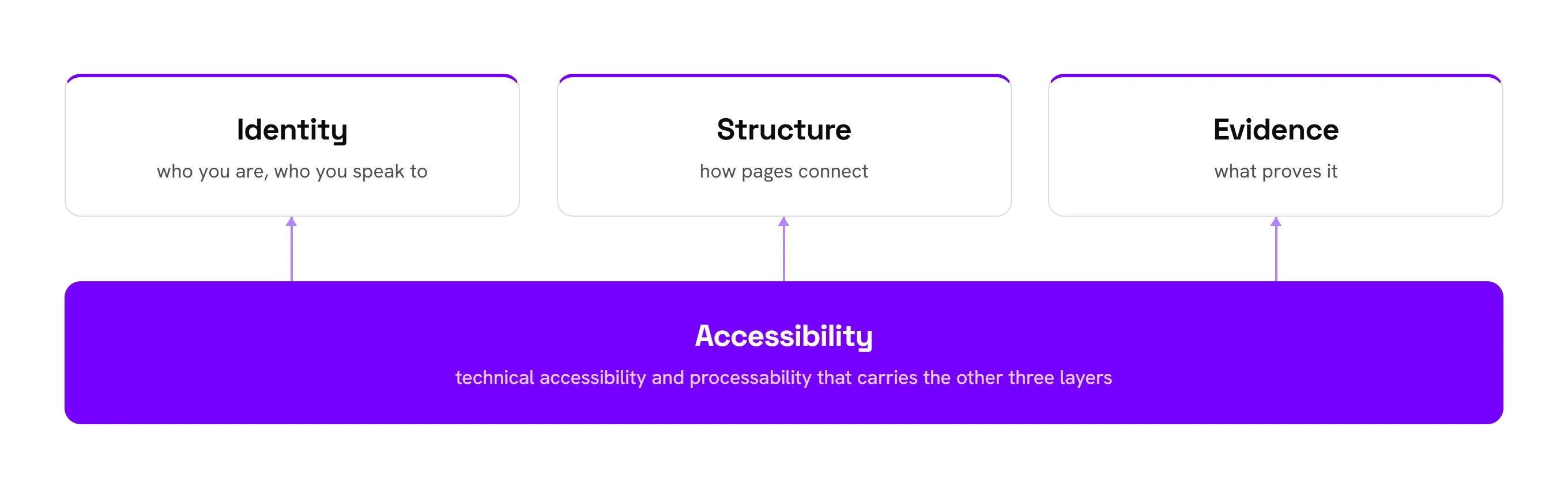
Identity
Question: Is it clear who the company is, what it offers, to whom, and in what situation?
Answer: A strong website doesn't settle for "web development" or "digitalization." It explains what problems it solves, which situations the offer fits, and where its boundaries are.
Bad example: "We offer complex digital solutions for every industry." This sentence tells neither a person nor a machine anything, because it contains no problem, no audience, and no boundary.
Good example: "We build multilingual WordPress websites for manufacturing and B2B companies when their existing website no longer supports international sales." A machine can read a category, an audience, and a situation out of this, and a decision-maker can immediately see whether it's about them.
A machine can only classify precisely what a company can articulate precisely.
Structure
Question: Is the information architecture clear, and are the relationships between pages clear?
Answer: The homepage, service pages, blog posts, case studies, and contact page shouldn't repeat the same generic copy, each has its own role in the decision-making process. There should also be a clear connection between the problem, the offer, the evidence, and the next step, without dead ends.
Bad example: The blog post, the service page, and the contact page repeat the same generic introductory copy under different headings, and by the end of the article the reader doesn't know what to do next.
Good example: The blog post explores a specific problem and leads to a relevant service page, the service page makes the offer decidable, and the contact page reduces the next step to a single, simple action.
A clear division of page roles helps a crawler classify and helps a person navigate, at the same time.
Evidence
Question: Can the claims on the website be verified and proven?
Answer: Saying "we're reliable" isn't evidence on its own. A precise description of how you work, transparent trade-offs, understandable technical decisions, and cited sources carry far more weight.
Weak evidence: "With years of experience, we support our clients as a reliable digital partner."
Stronger evidence: "We designed the new website for five countries, multiple languages, and nearly 500 subpages."
Evidence typically includes things like a concrete case study, measurable project data, a client reference, a professional source, clearly attributed authorship or expertise, dates and update information, a specific methodology, and verifiable technological or business claims.
Concrete, verifiable evidence gives both people and automated systems more usable information than a generic marketing claim.
Accessibility
Question: Is the information technically accessible, processable, and structured?
Answer: This is the technical layer that determines how reliably machines can access and process the information carried by the other three layers. It includes, among other things:
- semantic HTML and a consistent H1–H6 structure
- a clear, descriptive URL structure
- internal linking with descriptive anchor text
- canonical handling for duplicate content
- Organization, Service, Article, and Breadcrumb structured data, per the schema.org standard
- visible authorship and publication, update information
- clear brand and entity identification on the page
- crawlability and indexability, with clean robots.txt settings
- a deliberate AI crawler policy
- a technical implementation where critical content doesn't unnecessarily depend on client-side JavaScript rendering, and remains reliably accessible to relevant crawlers
If this layer is neglected, your positioning becomes much harder to interpret, no matter how precise your Identity, Structure, or Evidence layers are.
This layer isn't glamorous, but it's the foundation that makes the other three layers readable at all.
What reads as marketing fog to a person reads as unclassifiable noise to a machine.
The most common mistakes
We see four mistakes most often when a company starts working on machine readability.
The first is treating machine experience as just another SEO module that can be bolted onto an already fragmented structure. If services are vague, duplicate pages compete with each other, and internal linking is random, one new CMS field won't fix the underlying system.
The second is writing exclusively for AI answers. This easily leads to bloated FAQ blocks, overstuffed schema markup, and copy that looks machine-friendly but exhausts a human reader. Strong machine experience isn't a trick, it's clarity.
The third is blocking or allowing bot traffic without any strategy. Managing AI crawlers is best treated as a deliberate visibility and content-protection decision. Different providers use different bots and usage patterns, so it rarely makes sense to automatically allow everything or block everything.
The fourth is unmanaged content. A pile of AI-generated pages, long-forgotten blog posts, half-finished service pages, and contradictory claims doesn't build trust, it generates noise. A machine typically amplifies that noise rather than turning it into a clear position.
What it costs to ignore this
The honest question isn't what it costs to build machine experience, it's what it costs when a website is still online in 2026 but its new readers can't understand it.
It costs visibility in the moments when users no longer search the classic way. It costs trust when an AI summary describes your offer inaccurately or too generically. It costs inquiries when people can't see why they should talk to you specifically. And it costs time, because every sales conversation starts over from the basics that the website should have already clarified.
A lack of machine readability isn't a scare tactic, it's a concrete architecture problem. Websites with clean structure don't just win with AI systems, they also become better for people, with clearer navigation, stronger service pages, and easier-to-follow decision logic.
The cost of machine readability is invisible. The cost of its absence isn't.
What does a machine understand from your website? A quick mini-audit
The questions below let you quickly assess where your own website stands today, across the Identity, Structure, Evidence, and Accessibility layers.
Is it clearly identifiable what the company does?
Is it clear exactly who the services are for?
Do the key services each have their own, clearly defined URL?
Are the claims backed by references, case studies, data, or sources?
Does the company consistently say the same thing about itself across every important page?
Is the HTML and heading hierarchy clear?
Is there a logical connection between the problem, the service, the evidence, and getting in touch?
If several of these questions leave you uncertain, it's worth exploring with a more thorough, site-wide review.

How we put this into practice
For us, the Identity, Structure, Evidence, and Accessibility model doesn't stay theoretical, it maps directly onto our workflow. Strategy maps the Identity and Structure layers, in other words, where your website's decision logic breaks down today. Creative builds out the Evidence layer with clear, provable communication that doesn't just claim, it proves. Development implements the Accessibility layer, the semantic HTML, structured data, and technical readability foundations that machines can reliably read. And Support continuously monitors all four layers, through monitoring, freshness checks, and optimization, as AI systems and search behavior keep evolving.
If you're curious where your own website stands across these four layers, we're happy to walk through it with you.
In the years ahead, the websites that win will be the ones that both people and machines understand precisely.